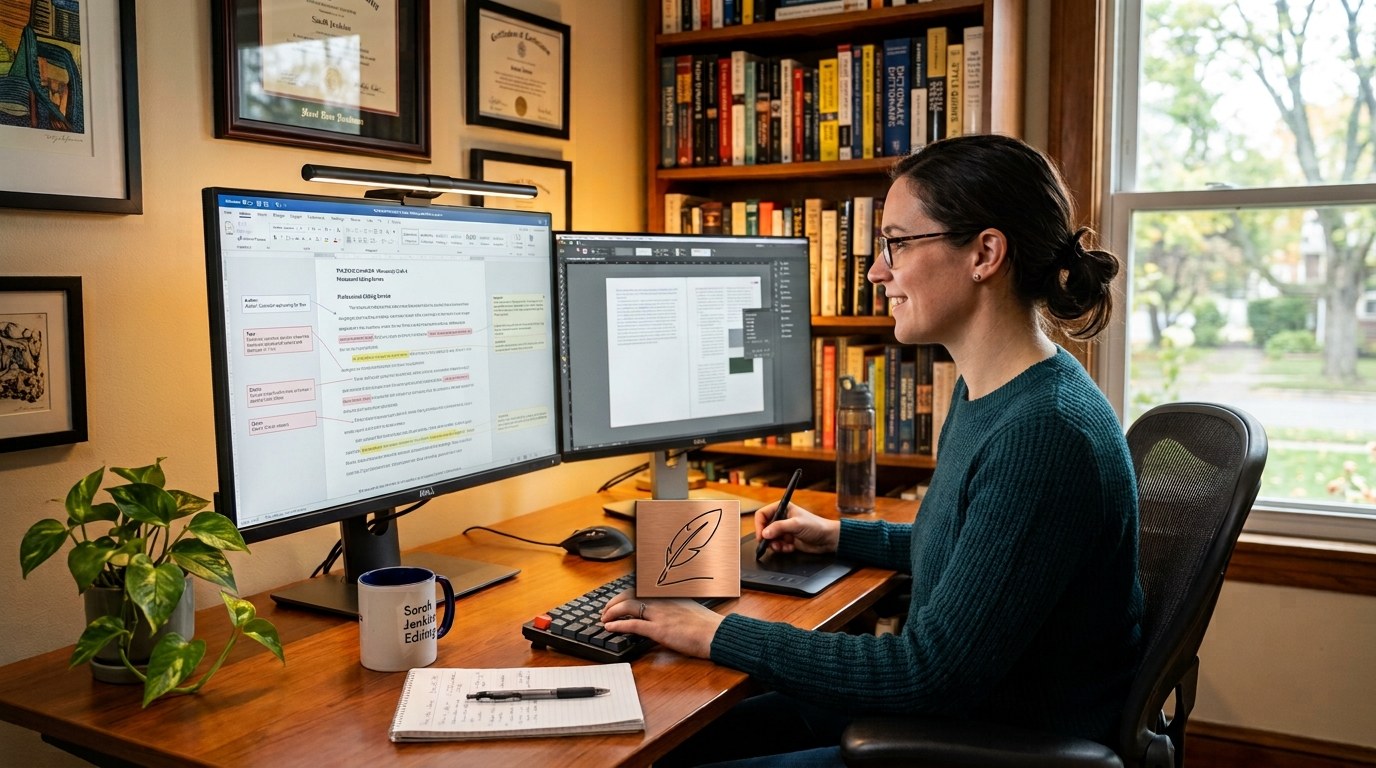

Manual humanizing, writing support, line-by-line proofreading and precise formatting, handled by editors with real advanced degrees in your field.
Your AI-assisted draft rewritten sentence by sentence by a real editor, by hand and never with AI tools, so it reads like a person wrote it, in your voice.
From a shaky outline to a full first draft — our editors help structure arguments, tighten thesis statements and build paragraphs that hold up under scrutiny, in your voice.
Line-by-line correction of grammar, punctuation, spelling and flow, tracked so you can see and accept every change. Nothing rewritten without a clear editorial reason.
Send your marked-up draft and reviewer notes. We resolve each comment individually and leave a short note on how it was handled, so nothing gets missed on resubmission.
Citations, headings, tables and reference lists set to APA, MLA, Chicago, Harvard or your institution's own guide — checked against the current edition.
Many researchers now use AI tools to draft, and are left with text that is grammatical but stiff: the same sentence shapes, safe vocabulary and vague claims from page to page. Our editors turn that draft into writing that sounds like a thoughtful person wrote it, and that you can confidently stand behind.
We do not promise particular AI-detector scores, and we do not help hide AI use where your institution or publisher requires it to be disclosed. Detectors are inconsistent and can flag genuine human writing, so we focus on real quality, your own voice and honest disclosure.
Manual humanizing and rewriting sits at the centre of what we do. Around it is a complete editing, proofreading and compliance service, so one team can take your document from rough draft to submission-ready.
We rewrite flat, generic AI-produced text by hand, never with AI tools, so it reads naturally, with varied rhythm, concrete phrasing and a voice readers can follow.
We study your earlier writing and reshape the draft to match your tone, vocabulary and way of building an argument.
We remove stacked transitions, repeated sentence openers, filler phrases and the over-polished sameness common in machine drafts.
A structured review of accuracy, unsupported claims, invented citations, tone and logic, with a marked list of what needs fixing.
Careful correction of clarity, grammar and flow, checked line by line by a human editor, not left to software alone.
We untangle long or clumsy sentences and tune paragraph length so complex ideas stay easy to follow.
Stronger word choice, precision and register, always without changing your original meaning or findings.
We tighten topic sentences, transitions and the line of argument from introduction to conclusion.
Clear explanations of methods, data and specialist concepts for examiners and readers outside your niche.
Business, policy and coursework reports restructured for clarity, tone and a professional finish.
Meaning-preserving rewording and reorganisation of passages, with every source kept properly attributed.
Editing that strengthens your own analysis and voice, and flags passages that lean too closely on a source.
We identify passages that are too close to sources or missing attribution, and advise how to fix them correctly.
An honest editorial read of which sections sound machine-written or generic, so you know what to rework. This is a review, not a guarantee of any checker's result.
APA, MLA, Chicago, Harvard, IEEE, Vancouver and more, corrected consistently throughout.
Every in-text citation matched to the bibliography, with missing, extra and mismatched entries reported.
Chapter-level and full-manuscript editing for structure, argument, consistency and language.
Margins, headings, tables, figures, contents pages and your institution's or journal's submission rules.
A final pass for non-native and native writers alike, delivered with tracked changes and a clean copy.
Fast, accurate mechanical correction for any document type, in UK or US English.
Our editors are matched to your discipline, so terminology, methods and conventions are handled correctly.
Every order follows the same path: subject-matched editor, first-pass rewrite, second-editor quality check, citation and reference check, then a final read for voice and consistency. You receive tracked changes, a clean copy and a brief editor's note explaining the main changes and anything you should verify yourself.

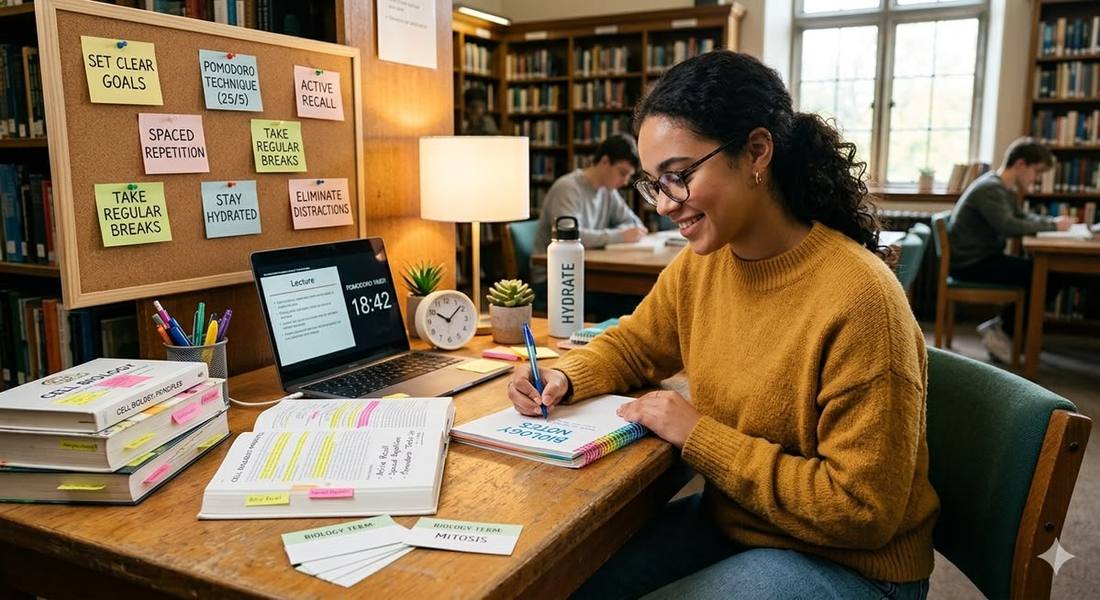
Upload your file, set the deadline, subject area and what kind of help you need.
We assign someone with a relevant academic background, not a generalist queue.
A marked-up copy, a clean copy, and a short summary of what changed and why.
Professor's follow-up comments? Send it back within 7 days, no extra charge.
The results was showingshow a clear correlation between the two variables, which it is important to noteis notable given the limited sample size.
Further research studies should address the confound raised in Section 3.2the previous section.
The results show a clear correlation between the two variables, which is notable given the limited sample size.
Further research should address the confound raised in Section 3.2.
Every change is explained, not just made. You'll always receive the marked-up file, so you can see exactly what moved and why, plus a clean copy that is ready to submit. Each tracked edit is a visible decision rather than a silent overwrite, which means you stay in control of your own work from the first page to the last. If a change is a judgment call rather than a rule, your editor leaves a short comment instead of quietly rewriting your argument, so you can accept it, reject it or discuss it. Grammar corrections, tightened phrasing, restructured paragraphs and reference fixes are all labelled, and every batch of changes ends with a brief summary written in plain language. Nothing about your ideas, data or conclusions is altered without your knowledge. That transparency also helps you learn: after a few orders, many clients notice their own recurring habits and start correcting them before a draft ever reaches us.
Every editor holds an advanced degree in the subject they edit — a comment on your methodology section needs someone who understands the methodology.
"My advisor's comments were all over the margins. Brawn Editors worked through every one and explained the fix — my resubmission was accepted without another round."
"Formatting the reference list to the journal's exact style would've taken a full weekend. It came back correct, with a note on the two citations I'd gotten wrong."
"English is my second language, so I was nervous my thesis wouldn't read naturally. The editor kept my argument intact and just made the sentences work."
Get a free, itemized quote in minutes based on word count, subject and turnaround time.
Order NowIt means one of our editors reads a machine-produced draft and reworks it by hand so it sounds like a thoughtful person wrote it. We never run your text through AI tools or automated “humanizers”; every sentence is rewritten manually by a person. We vary sentence length and rhythm, replace vague or generic wording with precise language, remove repeated patterns, and shape the tone to match your own earlier writing. Your ideas, data, arguments and citations stay exactly as they are; only the wording and structure change. We also check that every claim and reference is real, because AI tools sometimes invent sources. You receive tracked changes, a clean copy and a short note, so you can see what was changed and why before you submit anything.
We cannot promise that, and we would be wary of anyone who does. AI detectors disagree with each other, change with every update, and regularly flag writing that a person genuinely produced. What we can promise is careful human editing that improves clarity, voice and accuracy. If you want, we will also review your document and tell you honestly which passages still read as generic or machine-like, so you know what to strengthen. Please also follow your institution's or publisher's rules on AI use, including any requirement to disclose it, since those rules matter far more than any software score.
No. Our editors change wording, structure and flow, never your substance. Your research questions, results, interpretations and conclusions remain yours. When we notice something that looks factually weak, unsupported or inconsistent, we do not quietly fix it; we leave a comment explaining the concern so that you can decide what to do. Every alteration appears as a tracked change, which means nothing happens invisibly. If you disagree with an edit, you can reject it in one click, and if you would like a different approach, your free revision round lets you send the document back with instructions.
Yes, and this matters especially for AI-assisted drafts. Language tools sometimes produce references that look convincing but do not exist, or attach real sources to claims they never made. Our editors match every in-text citation to your reference list, flag missing, duplicated or mismatched entries, and try to verify that each source can actually be found. Where we cannot confirm a source, we mark it for you rather than guessing. We then correct the formatting throughout, so the style is consistent from the first citation to the last entry in your bibliography or reference list.
We work with APA 6 and 7, MLA, Chicago and Turabian, Harvard, IEEE, Vancouver, OSCOLA, and most journal or university-specific styles. Beyond citations, we can format headings, tables, figures, captions, page numbers, tables of contents, margins, spacing and front matter according to your institution's thesis guidelines or a publisher's submission checklist. If you have a template or a style sheet, send it with your files and we will follow it exactly. The finished document comes back consistent, compliant and ready for submission, with a short list of anything we could not resolve without your input.
Short documents under about five thousand words can often be returned the same day. Longer projects such as theses, dissertations and book manuscripts are quoted with a clear schedule before you pay, and large jobs are usually delivered chapter by chapter so you can begin reviewing straight away. Tell us your deadline when you submit, and we will confirm whether we can meet it or propose a realistic alternative. Rush delivery is available for urgent submissions, and we would rather tell you honestly what is achievable than promise something we cannot deliver.
Yes. Your files are used only to complete your order and are never shared, published, sold or reused for any other purpose. Only the editors assigned to your project can open your document, and they work under confidentiality agreements. We do not upload your writing into public tools or databases, and we delete files on request once your project and revision period are complete. If your institution or publisher has particular data-handling requirements, let us know before you send anything and we will confirm how we can meet them.
Email us at brawnwriter@gmail.com or use the order button on this page. Tell us the type of document, the subject area, the word count, your deadline and the kind of help you need, such as rewriting, proofreading, formatting or resolving professor comments. You can attach the draft or a sample chapter. We will reply with a fixed price and delivery date, and you only pay once you are happy with the quote. After delivery you have a free revision round of seven days for any follow-up comments.
A short framework for turning a vague professor comment into a concrete edit.
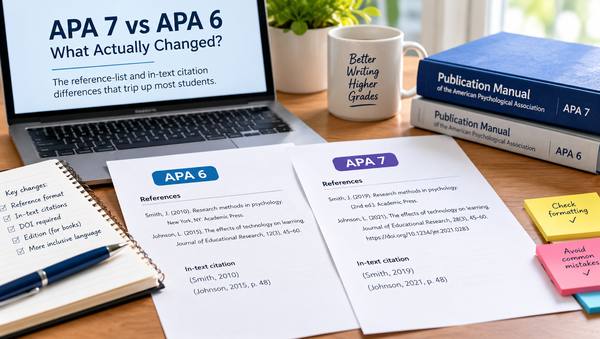
The reference-list and in-text citation differences that trip up most students.
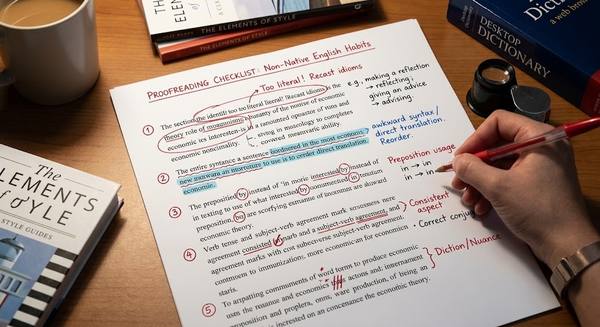
Patterns non-native writers can flag in their own drafts before submitting.